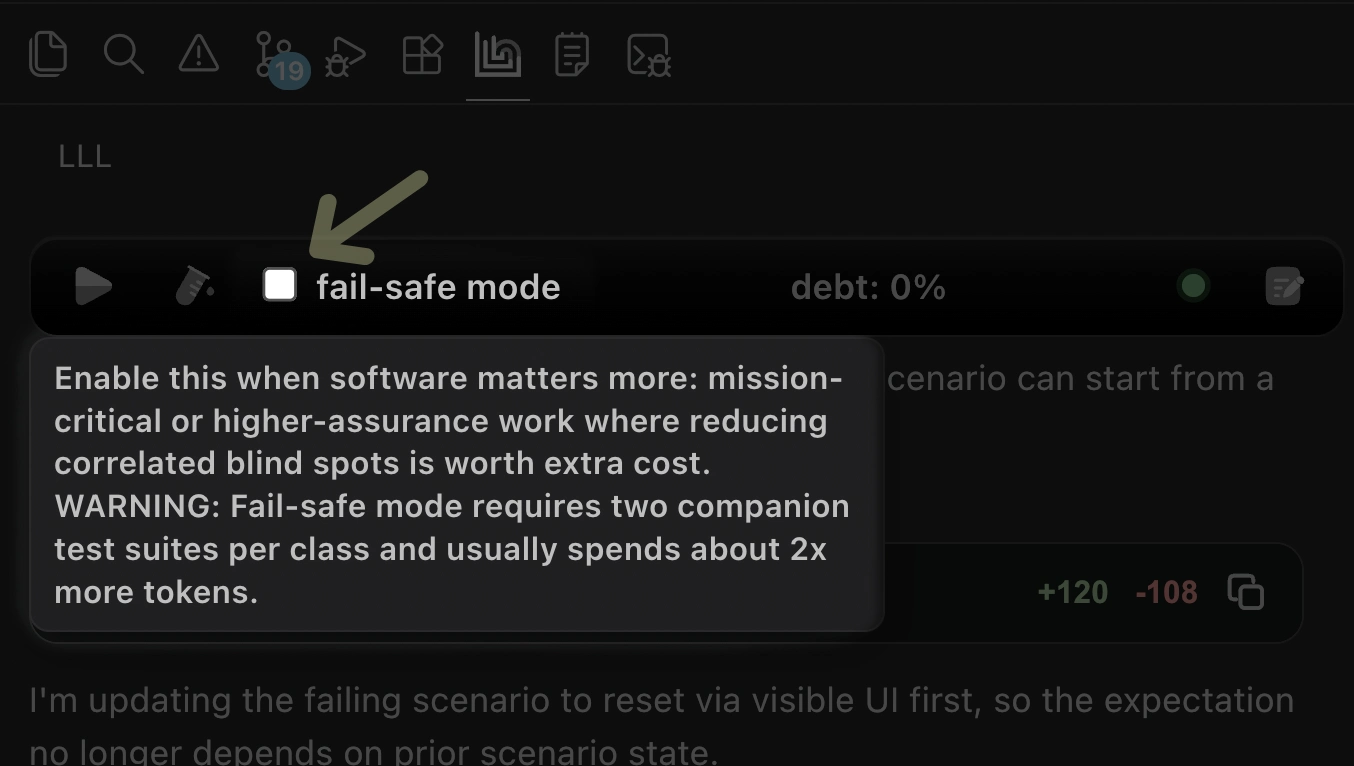
What fail-safe mode is
Fail-safe mode is the higher-assurance path in LLLTS.
It is not just "more testing." The point is to raise the reliability bar when software matters more by making the compiler and workflow demand more evidence.
Today that extra evidence is mostly about companion test structure. Over time, fail-safe mode is intended to grow into a broader contract layer.
Implemented now
Current LLLTS fail-safe mode can be enabled in either of these ways:
- in the CLI, pass
--fail-safe - in the VS Code plugin, turn on the
fail-safe modecheckbox in the top status bar
When enabled, the compiler changes test enforcement in two important ways:
- coverage debt diagnostics are disabled
- every class-exporting primary file must have two companion suites instead of one
That means:
ClassName.lll.tsstill requiresClassName.test.lll.ts- it also requires
ClassName.test2.lll.ts - the first companion must export
ClassNameTest - the second companion must export
ClassNameTest2 - each companion must declare
testType - each companion must include at least one static async
@Scenario
The current compiler does not yet prove that the two suites are meaningfully different. That distinction still depends on deliberate authoring.
Why this is separate from testing
Testing is only part of fail-safe mode.
The long-term direction is a broader higher-assurance configuration where stronger guarantees can be turned on together instead of being treated as isolated test features.
That future direction is expected to include:
- invariants
- stronger contracts around behavior and assumptions
- additional fail-safe-specific checks beyond today's dual-suite requirement
So fail-safe mode should be read as an extra assurance profile, not as a synonym for test coverage.
Positioning
Fail-safe mode is for cases where reducing shared blind spots is worth extra cost.
That cost can include:
- more structure to maintain
- more generated test material
- more tokens and runtime
- stricter expectations before a result counts as acceptable
It is a stronger discipline path, not a claim of perfection.